
Dr. Bronner’s “All-One Activist” series profiles influential activists who are advancing the core causes that Dr. Bronner’s supports through its philanthropy and advocacy.
As part of our ongoing All-One Activist series, we are highlighting the organizations supported through the All-One Canada Initiative, the Canadian chapter of Dr. Bronner’s All-One International Initaitive. Through this initiative, at a minimum, 1% of sales from participating international markets is donated annually to support local efforts focused on social justice, environmental sustainability, and animal advocacy.
In 2020, a mass movement surged across the United States, Canada, and many other parts of the world, fueled in part by outrage in response to the police murders of George Floyd, Breonna Taylor, and the many other victims of police violence. The overwhelming outpouring of solidarity and calls for racial justice renewed attention to the violent and traumatic experiences that Black people endure as a result of white supremacy, systemic racism, and criminal justice policy. Waves of protest underscored the urgent need to address these issues through comprehensive and systemic change. Black-led anti-racist advocacy organizations like the Movement for Black Lives and Black Lives Matter Canada experienced a surge in financial donations, and many companies made significant changes to their policies and embraced Diversity, Equity, and Inclusion (DEI) initiatives, signaling a commitment to fostering a more inclusive and equitable work environment and a more just world.
However, in recent years, several of these same companies that had previously expressed strong commitments to supporting marginalized communities have begun to retract or discontinue their DEI initiatives and related policies due to economic and political pressures. As a result, many advocacy groups fighting for racial justice are also reporting a decline in funding for their efforts. Despite these financial setbacks and the retreat of some corporations from their commitments to diversity, many anti-racist organizations continue to press forward in their mission to support disenfranchised communities.
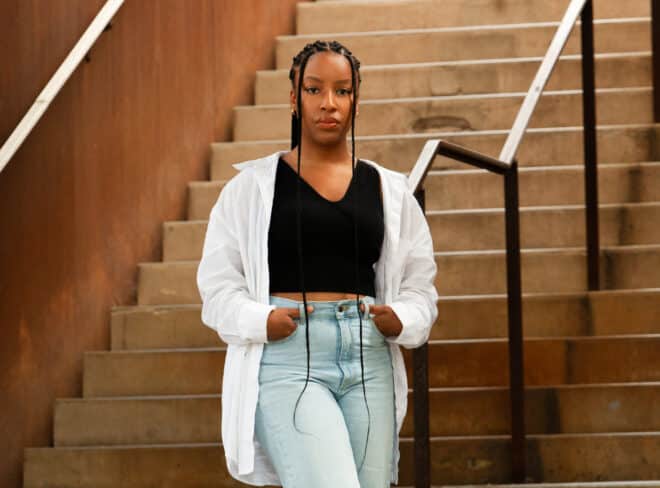
Recently, our PR team had the privilege of speaking with Jessica Kirk, a member of Black Lives Matter Canada—an organization with chapters across Canada dedicated to dismantling all forms of state-sanctioned oppression, violence, and brutality against Black communities. She is also the executive director of the Wildseed Centre for Art & Activism, a multipurpose community space that serves to nurture radical Black experimentation and creation. Wildseed also functions as headquarters of the national network, Black Lives Matter Canada.
Dr. Bronner’s has supported Black Lives Matter Canada through the All-One Canada Initiative since 2021. The organization’s unwavering commitment to Black liberation, and their resilience in a challenging political and economic climate is a powerful story of hope and resistance.
Editor’s Note: Dr. Bronner’s support for the Black Lives Matter Canada network, is in addition to its ongoing support for the Movement for Black Lives in the U.S.
What is Black Lives Matter Canada’s mission, and what work or programs bring that mission to life?
Alongside Wildseed Centre for Art & Activism, Black Lives Matter-Canada (BLMCA) is part of a multidivisional organization fighting for justice and liberation for all Black communities and individuals from coast to coast to coast, and creating spaces for building community. The Centre’s focuses are threefold: offering artistic and educational programs, delivering services, and providing equitable access to bookable space. On the other hand, BLMCA brings our shared mission to life in two ways – by providing public education and resourcing grassroots activists across Northern Turtle Island and globally.
How did Black Lives Matter Canada get started, and how did you come to work with them? What does the work mean to you personally?
Black Lives Matter Canada was founded in 2018 by some previous members of Black Lives Matter-Toronto (BLMTO). The local chapter was established in 2014, and over the years BLMTO organized direct actions and advocated against policing and anti-Black racism in the city and across Canada. Recognizing the limits of their regional capacity and the shared interests in doing this work by activists across the country, Pascale Diverlus, Rodney Diverlus, Sandy Hudson, Janaya Khan, Syrus Marcus Ware, and Ravyn Wyngz reoriented their efforts to establish a network of activism. The grassroots groups involved with BLMCA each share a set of commitments in service of dismantling state sanctioned brutality committed against all Black communities – African, Caribbean, Afro-Indigenous, migrant, queer, trans, and disabled Black communities.
I’ve had the privilege of being involved with this work in various capacities throughout its history. When BLMTO was active, I was involved with the group as a volunteer and a marshal during protests. Shortly after the Black Lives Matter movement regained momentum, I was offered the opportunity to serve as BLMCA and Wildseed Centre’s inaugural Executive Director in 2021.
How has Black Lives Matter Canada’s work evolved during your time with the organization? Are there any key milestones or shifts you’ve seen?
One of our movement’s biggest accomplishments has been seeing the amount of opportunities that cultural shifts have created for Black people. Over the past 10+ years, the Black Lives Matter (BLM) movement in Canada has forced government and institutions to acknowledge and respond to anti-Black racism, shifting the ways they each show up in support of the most vulnerable people in our communities.
Another huge accomplishment for our organization has been the acquisition of permanent, enduring space through the Wildseed Centre. Since BLMTO’s organizing, ‘Black Space Matters’ has always been a repeated mantra of its efforts. Seeing a slogan move from concept to realization in real time, and its impact on Black and allied communities has been incredible.
What are some of the biggest challenges the organization faces, and how do you work to navigate or overcome them?
Three biggest challenges that come to mind are burnout, repeals, and revenue. Advocacy is no easy feat as is, but some of our members like BLM Sudbury, BLM YYC/Calgary, and BLM Nogojiwanong/Peterborough have shared that drawing on personal community experience in order to appeal to their audiences and build momentum can be dehumanizing and exhausting. In response, BLMCA has planned multiple retreats for organizers across the country, where they could share experiences with one another, reconnect with each other, themselves, and the land.
Repeals and revenue sort of go hand in hand. In 2020, many people and companies declared their commitments to meaningfully challenge anti-Black racism. It has been through that support our organization has been able to afford an investment in the purchase of a permanent, Black-owned community hub in the heart of Downtown Toronto. But 5 years later, it’s been really heartbreaking to bear the brunt of the plummet of support for purpose-driven work, especially since that is what sustains our operations as a non-profit organization. As a member of a small team of 4, I often find myself scrambling for granting opportunities while also managing a 10,000 sq ft rentable space, running independent programs, and supporting a national network of grassroots efforts. It has been helpful to remind our supporters that in a moment of universal uncertainty around the rise of far-right extremism, now is exactly the time when donating to community organizations is most impactful.
What’s a common misconception people have about racial justice work?
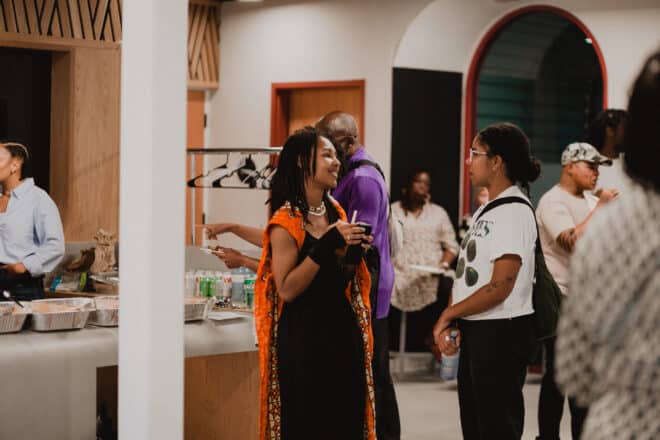
There’s a misconception that fighting for racial justice is destructive and divisive. Getting to root of those misconceptions, Black people are often viewed as more aggressive no matter what we do. Objectively though, we know that expressing the rage we feel from witnessing our families, friends and neighbours harmed by police and other forms of violence is a healthy form of release. What makes Wildseed Centre so magical, is that we’ve been able to both establish and host initiatives that respond to racial injustice in so many creative and meaningful ways. At the Centre, Black trans-led groups have run sewing classes, Palestinian-led groups have led know your rights workshops and tatreez classes, book clubs have shared spaces responding to works by revolutionaries like Angela Davis. Through these initiatives, each group has devised tangible responses to racial injustice and unified community.
Are there other movements, organizations, or approaches you find especially inspiring or aligned with your vision for change?
As a network for grassroots organizing, we’ve been inspired by local and international land defense efforts by Indigenous people. Within the Canadian context, Indigenous groups have been leading the charge to challenge the approval of Bill-5 in both the province of Ontario and Canada. Both bills have become law, expedite development proposals and undermine Indigenous right to free, prior and informed consent over development proposals that affect their territories.
We have also been inspired by Afro-Indigenous land defenders in Honduras’ Garifuna community, who have similarly challenged development projects despite growing surveillance and unsafety for putting their bodies on the line. We know there is no Black Liberation without Indigenous Liberation, either here on Turtle Island or beyond.

Why is an interconnected or “All-One” approach important to the broader work for social justice?
Maya Angelou once said “no one of us can be free until everybody is free.” At BLMCA and Wildseed Centre, we deeply resonate with this quote and its connection to Dr. Bronner’s “All-One” philosophy. We draw inspiration from environmental and Indigenous justice efforts like the examples provided above, because we know the inherent value in not only caring for our neighbours, but in understanding plants, animals and the land as allied community members that requires protection as well. Racial justice work often fosters the creation of social services that improve conditions for everyone. In the same way, responding to calls to action by anti-colonial environmental efforts improves all our livelihood.
How can readers best support your work?
We wouldn’t be anywhere near where we’ve gotten to date without support from people and organizations who share our values of creating our own liberation in spite of the ugliness surrounding us. The best way to support is by donating directly to our divisions. Or, you can book the Centre for private use if your own work is based here in Toronto.
How has Dr. Bronner’s support helped advance your work, and why is it important that companies like Dr. Bronner’s invest in racial justice efforts?
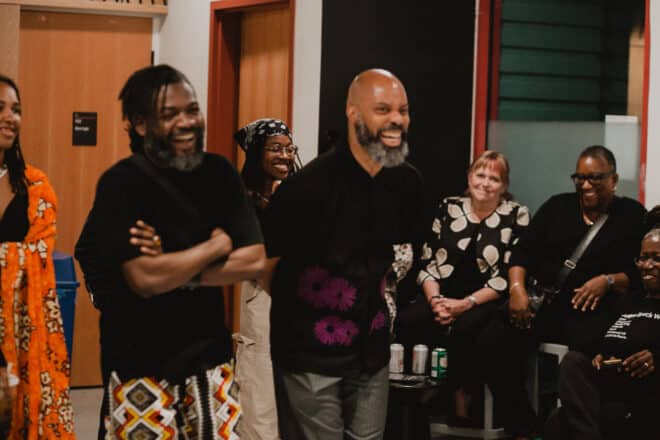
Dr. Bronner’s has demonstrated unwavering support for our efforts since 2021. They’ve provided needed funds that have supported our operations and Wildseed Centre programs such as the Earthseed Community Garden and Liberation Library. When we had our library’s launch event in 2024, all attendees were given free Dr. Bronner’s products. With the extra products, we were able to stock our Community Pantry with extra Pure-Castile Magic Bar Soap for unhoused neighbours.
We’re always inspired by companies who recognize that #BlackLivesMatter represents more than just a moment in time. Consistent investment in our movement by individuals and organizations, is part of what creates lasting change for the most vulnerable in our society.
What’s your favorite Dr. Bronner’s product and scent?
I’m obsessed with the 18-in-1-pure-castille magic soap! My partner and I keep a huge bottle of the peppermint scent in our washroom and use it for our body and bathtub cleaning. I’ve also been meaning to try the bar soap in your lavender scent.
Learn more about Black Lives Matter Canada’s work.
Explore the various events held at Wildseed Centre for Art & Activism.