
Dr. Bronner’s “All-One Activist” series profiles influential activists who are advancing the core causes that Dr. Bronner’s supports through its philanthropy and advocacy.
As part of our ongoing All-One Activist series, we are highlighting the organizations supported through the All-One Canada Initiative, the Canadian chapter of Dr. Bronner’s All-One International Initiative. Through this initiative, at a minimum, 1% of sales from participating international markets is donated annually to support local efforts focused on social justice, environmental sustainability, and animal advocacy.
Those who advocate for the rights and lives of our fellow animals have a long history of exposing the truth about factory farming and other harmful animal industries through undercover investigations. In response, big agriculture businesses have mobilized and pressured governments to implement ag gag laws – laws that limit and punish the various ways that activists gather information about animal agriculture operations. The less we know about factory farming, the better for factory farming–and the worse for animals and all of us who are affected by the impacts of industrial agriculture.
Canada has laws that appear to protect animals, but opaque processes, weak legal standards, exemptions, and lack of licensing and enforcement mean suffering for animals and trouble for advocates. As activists’ tactics evolve, so does legal backlash. Big ag is desperate to prevent undercover investigations, and a lot has been invested in criminalizing them.
Dr. Bronner’s All-One Canada partner since 2020, Animal Justice, Canada’s only national animal law advocacy organization, successfully challenged Ontario’s ag gag Bill 156 in 2024. Naturally, the Ontario government appealed. Animal Justice was back in court in June defending that challenge and awaits the Court of Appeal’s judgement.
Whether intervening in ongoing legal cases or filing new ones, Animal Justice uses the law to fight and fight back–not just for factory farmed animals, but for captive marine mammals, animals in zoos and labs, foxes and ferrets, horses, companion animals, farmed fish, and more. We interviewed animal rights lawyer and executive director of Animal Justice, Camille Labchuk, and asked her about the impact the organization is striving for, its evolution, and how they prioritize.
What is the work that Animal Justice does, why is it needed, and what should people understand about the impact you’re striving to make?
Animal Justice leads the legal fight for animals in Canada, with the goal of building a compassionate country where animals are respected, have legal protections, and enjoy the freedoms they deserve. Canadians care deeply about animals, and polls show that people are opposed to animal abuse like the fur trade, trophy hunting, rodeo, and more. But Canada’s laws don’t reflect these values—they’re usually heavily slanted toward protecting profits of the powerful industries that benefit from harming and killing animals. We aim to tip the balance toward animals, by pushing for stronger laws and corporate policies, suing to stop animal abuse, and ensuring the few laws that do exist are actually enforced.
What I hope people understand is that Animal Justice is relentless—we’ll leave no stone unturned in our mission to end animal suffering.
How was Animal Justice founded, and how did you come to work for them?
Animal Justice was founded in 2008 by a group of lawyers who believed that law was an incredibly powerful tool to make change for animals. I went to law school specifically to become an animal rights lawyer, so I got involved early on and spent a summer working with the organization as a law student. When I became the executive director in 2015, it felt like a dream come true—and it still does!

How has the work of Animal Justice evolved during your time with the organization?
In the early days, we were all volunteers, and the organization’s budget was still very small. As we started taking on issues and winning, offers of donations from the public and pro bono support from other lawyers poured in, and now we’re a team of around 20 full-time people.
All of our early court cases were interventions—participating in existing litigation to ensure the perspective of animals was included. Our first intervention was even at the Supreme Court of Canada! As we grew, we started filing our own lawsuits against governments, such as our successful lawsuit that defeated Ontario’s anti-whistleblower “ag gag” law in 2024.
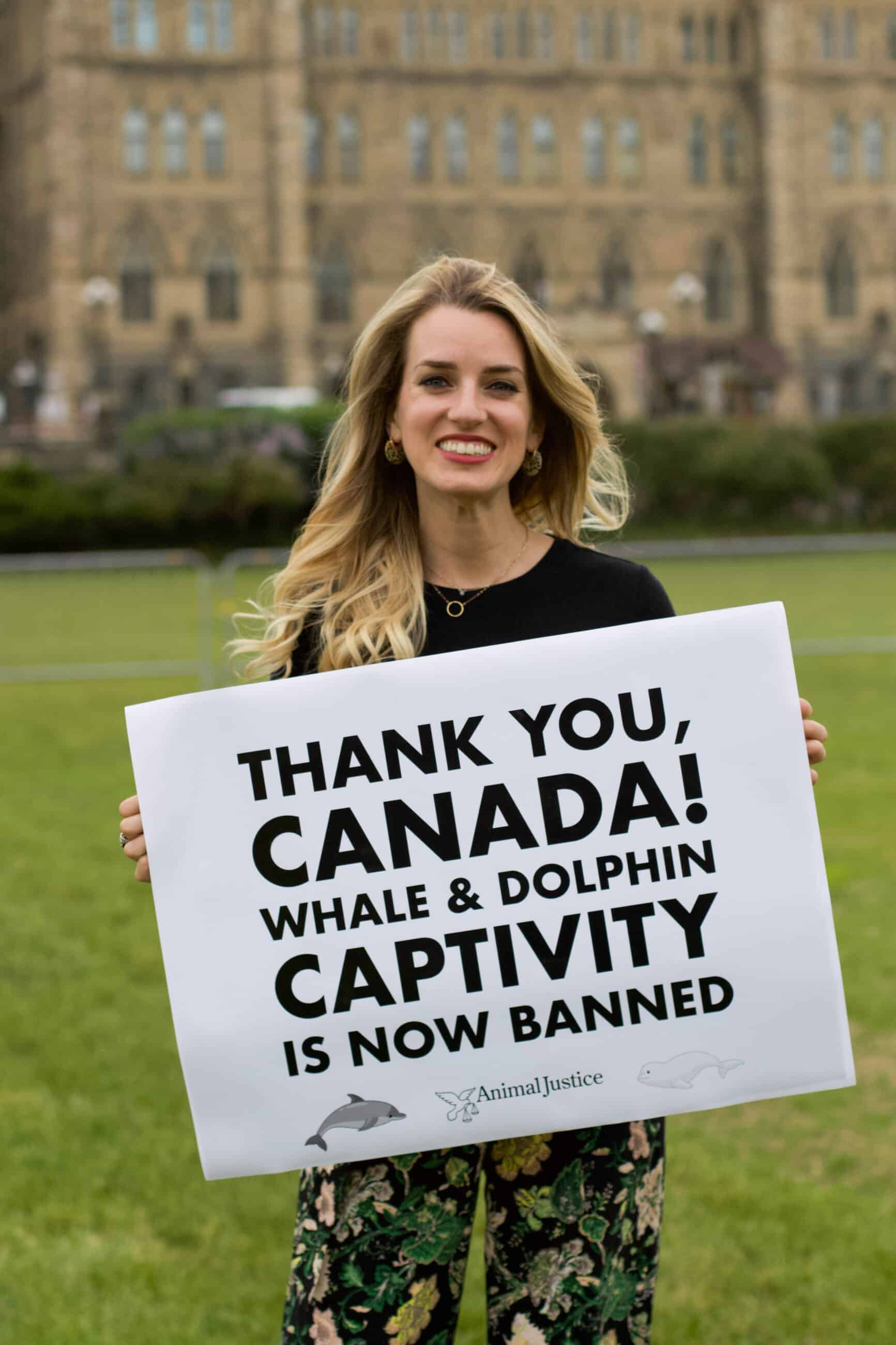
We’re also now in a stronger position to pass laws. Our first major legislative victory was in 2019, when we helped pass a national ban on whale and dolphin captivity. It was the first time in over 100 years that Parliament had passed a new animal protection law. Today, legislators view animal protection as a legitimate policy issue that they know voters support—we’re getting more and more wins.
What is a common misconception about animal advocacy work?
Most Canadians have no idea how bad our laws are. We view ourselves as a polite, compassionate country where the government takes care of the vulnerable. But not when it comes to animals—there are almost no laws regulating animal use in farming, lab experiments, or other industries. So we have a lot of work to do to shine a light on this problem, then encourage change.
How do you choose which issues to prioritize when it comes to animal justice, and what are some of the key issues you are currently focusing on (for example, addressing systemic legal and regulatory problems)?
We think carefully about how to be effective, and this often means speaking up for animals who are the most abused, and in the largest numbers—animals trapped in the factory farming system, like hens caged for egg production. We push for systemic change to improve the dismal conditions they endure.
But we also prioritize issues that we know the public and politicians are willing to move on. For instance, we have come very close to passing a ban on the live export of horses by air. Canada ships thousands of draft horses to Japan every year on airplanes, where they are fattened up and slaughtered for raw sashimi. Canadians find these exports abhorrent when they learn about the industry, and the vast majority of people want it outlawed.
Are there any movements or organizations that you find inspiring or promising at the moment, and how does Animal Justice help to support work being driven by other organizations?
All of them! It’s no secret that advocacy for animals, the environment, and human rights has felt more challenging in recent years. Governments and powerful corporations are making it more difficult and rolling back hard-fought wins. I’m inspired by all of those who refuse to give up.
We try to bring the animal protection community together through our annual Animal Law & Advocacy Conference in Toronto, with panels and presentations from Canadian advocates, lawyers, and scholars as well as those from around the globe. We also regularly feature the work of other animal protection activists and groups in public, online talks offered through our Animal Justice Academy project.
Why is an “All-One” or intersectional approach important to work for change?
It’s important to recognize that what’s bad for animals is often bad for people and the planet, too. For instance, factory farming produces obscene amounts of pollution and greenhouse gases. And slaughterhouse workers are often from marginalized communities, experience appalling labour conditions, and suffer trauma from the gruesome work they are forced to do. We work hard to build coalitions with other groups that share common goals and believe that we’re stronger together.
How has Dr. Bronner’s support helped advance your work, and why is it important that companies like Dr. Bronner’s fund this kind of impact?
One of Animal Justice’s greatest challenges has been to respond to the dangerous threat of ag gag laws in Canada—pushed by the industry and politicians in an effort to end undercover investigations and keep animal cruelty hidden behind the closed doors of farms. Ag gag laws strike at the heart of one of our most important tools to make change—showing people for themselves the suffering that occurs on factory farms.
Dr. Bronner’s has been by our side in fighting ag gag laws since day one. Since this fight began, we’ve been able to turn the tide—ag gag laws are now being defeated in legislatures instead of passed, and we’ve struck down Ontario’s ag gag law in court. Dr. Bronner’s partnership in this work has been essential.
How can readers best support your work?
Join our community! You can follow us on social media (Instagram, Facebook, Threads, Bluesky, X) and sign up for the Animal Justice email list to participate in our campaigns, donate, and be part of a mass movement to end animal cruelty. You can also join our Animal Justice Academy training program to take a free, self-paced online course to help you learn new advocacy skills.
What is your favorite Dr. Bronner’s product and scent?
I absolutely love Dr. Bronner’s Pure-Castile Magic Soap in Almond scent. The smell is unreal—I always have a bottle in my shower!
—
To learn more about the history of Canada’s ag gag laws, watch this 2024 talk by Thompson Rivers University (British Columbia) faculty member and animal law expert Katie Sykes.